
(Photo from Blogpost.)
Warning: This post does not contain photographs of actual human remains, however, some of the links below do.
All great Paleoanthropological stories begin in the past.
A concept first developed by Aristotle to classify organisms based on their ability to move and sense, as well as the temperature of their blood, took root in medieval Europe. Christian followers transformed this idea into what they called, the Great Chain of Being*. A cardinal example of Human Exceptionalism, the Great Chain of Being, placed all forms of life along a continuous chain or ladder. In it’s most simplistic expression, the Christian God sat at the top of the chain, below him were angels, followed by humans, then animals, plants, and finally minerals.

This hierarchical classification system continued to inspire thinking for centuries to come. Carl Linnaeus’s 1735, Systema Naturae created nested categories for life. Jean Baptise Lemark published Système des animaux sans vertèbres in 1801, proposing that biological evolution happened in accordance to natural laws.

This placement of all life forms within a supposed natural order was so enmeshed in western society that it also inspired poetry, as can be seen in this passage from the 18th century poet Young,
Look Nature through, ’tis neat gradation all.
By what minute degrees her scale extends!
Each middle nature join’d at each extreme,
To that above it, join’d to that beneath .
. . . . . . . But how preserv’d
The chain unbroken upwards, to the realms
Of Incorporeal life?
-full version can be found here.
The missing link.
The Great Chain of Being was the likely inspiration behind the earliest publication that explicitly used the term “missing link“. Published in 1844, Vestiges of the Natural History of Creation by Robert Chambers, used the words “missing link” to signify gaps in the chain of mankind. These gaps were later described as undiscovered transitional fossils. If found, these metaphorical “links” could fill in the evolutionary continuum from ape to modern human, and finally prove that humans descended from apes.
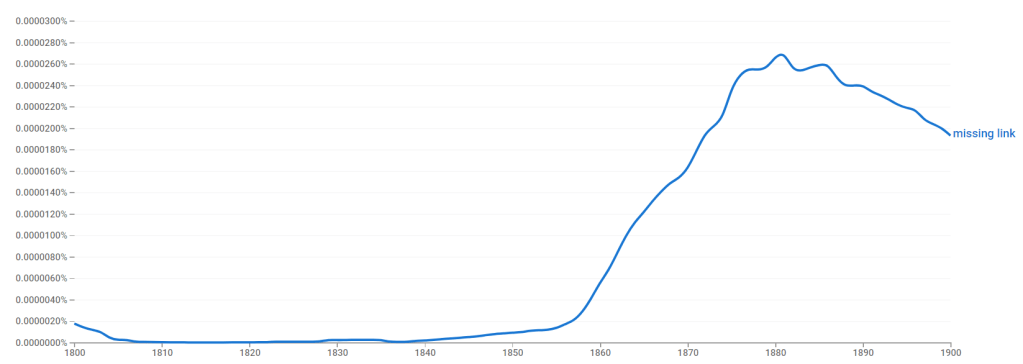
Google Ngram Viewer
Obsession to find the missing link was at an all time high; Charles Darwin, Thomas Henry Huxley, and Ernst Haeckel all used the term “missing link” in their work, further igniting generations of evolutionary enthusiasts keen to be the first to discover the “dark matter” of the paleoanthropological world. People seemed to know everything there was to know about the missing link―except where to find it.

Eugene Dubois was utterly transfixed by the idea of a missing link and began his search in while stationed in Sumatra, Indonesia as a Dutch army surgeon. In his free time, Dubois worked in Lida Adjer Cave, and quickly discovered a variety of fossilized animals remains, confirming his suspicion that fossilized bone could be found in Indonesia.
Dubois failed to find the missing link and in his frustration claimed, “everything here has gone against me, “in a letter to his friend and director of the National Museum of Natural History. He complained that his workers were “as indolent as frogs in winter”, ( a highly derogatory term used by colonialists throughout the archipelagos to describe indigenous people) and also noted that locals were keeping secret the locations of caves for fear they might be plundered. (Spoiler alert: they were!)

The bones unearthed.
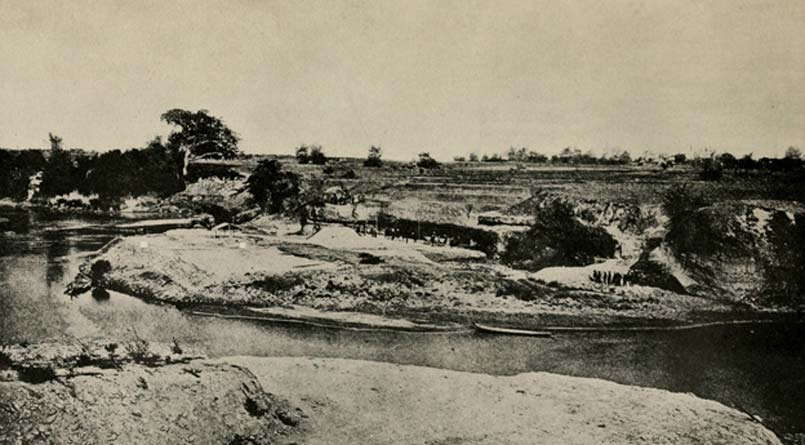
In 1891, after moving to Central Java and setting up an excavation on the shore of the Bengavan River, Dubois finally struck archeological gold; he discovered the oldest hominid fossils (at that time) which would later become knows as Homo erectus.
The vault of a 900 cc skull , a molar, and a femur were all discovered by Dubois between 1891 and 1892, and subsequently given their original name of Pithecanthropus erectus. This name is often translated as upright ape man from, pithec the prefix for ape combined with anthropus, often written as man, and erectus meaning to walk upright. Anthropus, however, simply means human―and the fossils themselves bear no signifier pointing to any particular any sex.

Dubois’s discovery was immensely significant due to the notable difference in the skull cap from the typical Homo sapien skull. A Homo sapien skull is globular and lacks a suborbital torus (brow ridge); the fossilized skull vault that Dubois found was long and low, and the brow ridge was large, so that it resembled more closely the skull of an ape, rather than a Homo sapien or modern human.

Meanwhile, the femur looked wholly similar to that of a modern human, suggesting an ape like hominid, who could walk upright―the missing link between Ape and Modern Human.

Sculpture: ©2010, John Gurche | Photo: Chip Clark, Smithsonian’s National Museum of Natural History
The bones leave Indonesia.
Dubois published his finds in 1894 claiming the bones―estimated to be between 1 million and 700,000 years old― came from the “missing link”. He wrote that they represented a single intermediary species positioned squarely between apes and modern humans. Critics were reluctant to bestow the title of “missing link” upon them. They believed the bones to be ape or human, but nothing in between.
Dubois spent the next year frustratingly defending his position. Then, in 1895 Dubois left Indonesia for the Netherlands to become a professor of Geology at the University of Amsterdam. Accompanying him on this trip home was his wife Anna, and the set of controversial bones.

Between 1894 and 1900, many scientists slowly began to come around to the idea that the fossils did indeed represent a missing link, but most continued to reject Dubois assertions that they fit squarely in the middle of the evolutionary scale. In 1900 at the World Exhibition in Paris, as part of one final attempt to assert his claim, Dubois presented a life-size model with a notable even spread of ape and human characteristics; public opinion was unchanged.

The bones that changed the world.
Dubois, recoiled into solitude taking his bones with him. He kept them hidden from the scientific community―presumably attempting to preserve his intellectual property rights and avoid further debate. Although Dubois may have felt rejected by his peers, his findings had a monumental impact. Scientists had not totally accepted Dubois theory, but it was still the first time in history that they had begun to accept a possible intermediary species of any kind.
Dubois died in 1940, leaving behind a legacy as the first person to go looking for the missing link. His work revolutionized the way in which many think about our human origins, and it has inspired many future paleo-anthropologists to follow in his footsteps. Since Dubois, many more important discoveries have been made such as : Homo heidelbergensis, the Taung skull, Sinanthropus pekinensis and so on.
Where are the bones now?
On January 13th 2020 43,000 articles, manuscripts, books and statues that comprise the Dubois archive were officially added to the Naturalis collection at the Museum Naturalis in the Netherlands. Housed alongside them are Dubois’ most famous finds: the bones of Homo Erectus that he brought back with him from Java. Exactly how or when they made their way to the Museum Naturalis remains a mystery, but one thing is for certain―they are a long way from home!
John de Vos, the retired former curator of the Dubois collection, claims that Indonesia has never shown interest in repatriating the Javanese fossils”. At least, it was never mentioned”, he says in an article from 2019. “I had a counterpart in Indonesia and lots of contacts in high places at the institutions and universities, but it was never the subject of discussion”.
Don’t wait―repatriate!

Museums and institutions throughout the western world have often waited for repatriation claims to be filed before they consider taking action. Museums can and should begin the conversations surrounding repatriation instead of waiting for someone else to do it. The process of returning artifacts and human skeletal remains to their places of origin should be at the forefront of all conversations within Anthropology.
Evelien Campfens, from the Grotius Centre for International Legal Studies, is doing her doctoral research on looted art, and says in an article from Mare Online, “there are special rules for human remains…but it must be done so they can be respectfully repatriated.” **

This author agrees, and strongly urges the Museum Naturalis in the Netherlands to begin the important process of repatriating the bones that Eugene Dubois removed from Indonesia 125 years ago.
Further Resources:

**For more information on the subject of repatriating prehistoric remains there is a thought-provoking article which can be found here.
 Jenny Digs


Your blog is GREAT! It has so many interesting facts and research. I especially liked your use of visuals. It was fun to read, and I didn’t feel like I was having to make myself keep reading because I was fully engaged. I also think you did a great job of citing all your sources so that readers can visit those sites for themselves a swell. Overall great work!
LikeLike
Thanks, J.A. I am a visual learner myself, so I find pictures very useful. I am glad you enjoyed the post.
LikeLike
I like it when folks come together and share views. Great website, keep it up!
LikeLike
Thanks Valentin!
LikeLike